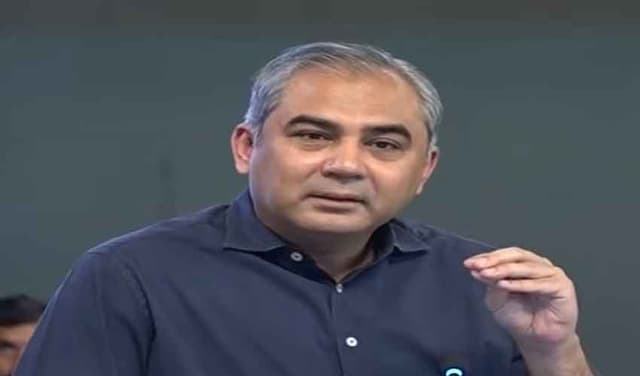

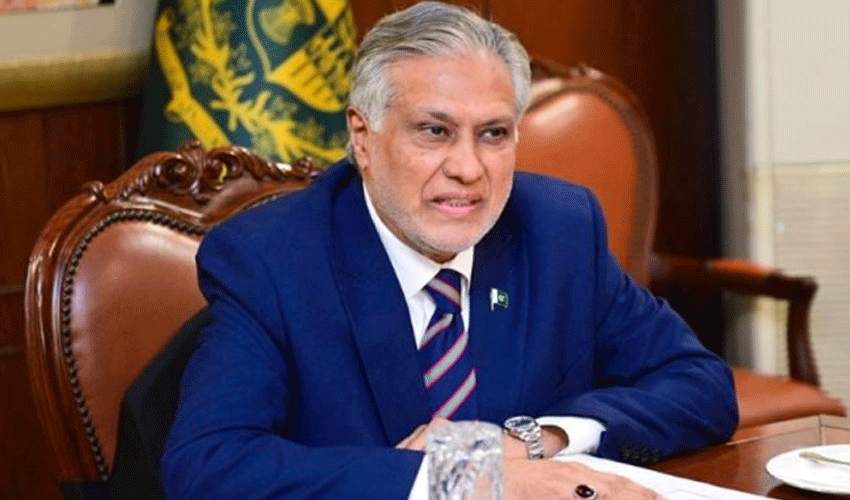
Deputy Prime Minister Ishaq Dar said on Sunday a comprehensive response strategy was formulated with joint civil-military leadership, including discussions on how to response to India.
Expressing his thoughts on Samaa TV's special transmission, "Samaa Control Room", Dar said that Prime Minister Shehbaz Sharif personally led the efforts from day one of the crisis until the ceasefire, keeping the world informed moment by moment about the evolving situation.
Dar stated that Pakistan remained in contact with over 100 embassies, ensuring diplomatic engagement throughout. He congratulated the nation on the valiant efforts of the armed forces. Dar said that Pakistan Muslim League-Nawaz (PML-N) President Nawaz Sharif was involved in advisory consultations during the entire operation and that Prime Minister Shehbaz had also consulted other political parties.
Recalling a critical moment, Dar mentioned that during the Pahalgam incident, Prime Minister Shehbaz Sharif was in Ankara, actively managing diplomatic efforts. Dar said: “We had to send a united message to the world.” He detailed that from 23 April to 6 or 7 May, tensions escalated. “When India launched its attack, we responded by downing their aircraft,” he said.
"Diplomatic outreach and other strategic initiatives were also part of the response. We informed members of the UN Security Council of the developments and maintained transparency regarding Pahalgam, ensuring a clear and impartial investigation,” he added.
"By May 5, the global call was for restraint. We had made it clear that Pakistan would respond with patience and dignity—but if attacked, we would retaliate,” he said.
He asserted, “We did exactly what we said.” Pakistani pilots were instructed to target enemy aircraft suspected of carrying payloads; out of 10–12 aircraft, five were shot down.
Meanwhile, other nations were urging us to submit a request to India for de-escalation. India launched multiple missile strikes—three landed in Amritsar, and one entered Pakistani airspace, which was subsequently neutralised.
On May 8, Pakistan shot down 29 Indian drones, while by May 9, Indian drones had reached several Pakistani cities. That night, when Indian forces attacked Pakistani military bases, tensions peaked.
"PM Shehbaz responded, declaring, “Enough is enough. American officials confirmed that no F-16 aircraft had been downed."
"A comprehensive response strategy was formulated with joint civil-military leadership, including discussions on how to respond to India. On 9 May, a third country advised Pakistan to agree to a ceasefire. Diplomatic communications resumed on May 10," Dar said.
Dar criticised the perception of India’s military supremacy, stating that such narratives were unacceptable. He confirmed that a Director General Military Operations (DGMO) level contact is scheduled, with discussions to be held in a neutral location.
He acknowledged that the United States played a key facilitative role between Pakistan and India, and concluded by noting that the next phase of this process would soon follow.
– Bilateral call between Dar, Algerian foreign minister –
In a separate development, Deputy Prime Minister Ishaq Dar received a telephone call from Algerian Foreign Minister Ahmed Attaf.
Minister Attaf appreciated Pakistan’s firm commitment to regional peace and stability. Both leaders agreed to maintain close coordination on multilateral forums to pursue shared objectives.
The Algerian foreign minister also welcomed the ceasefire agreement between Pakistan and India, describing it as a "positive step" towards lasting peace in the region.