
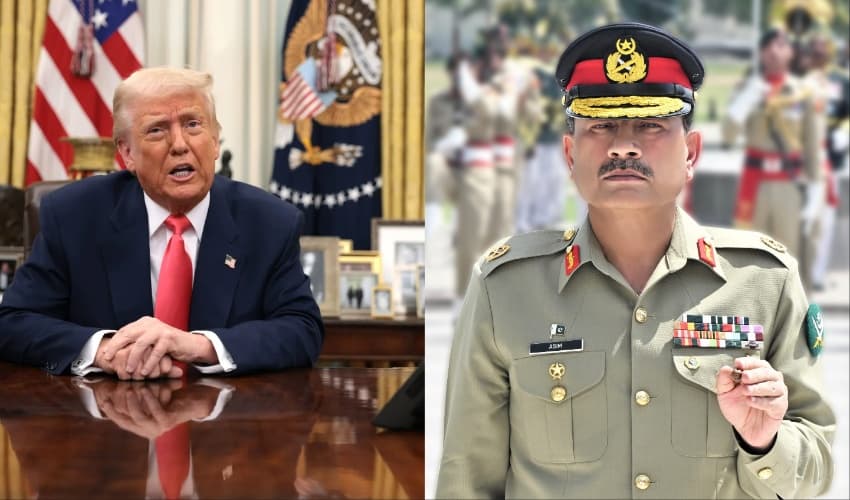
In what analysts are calling a potential strategic reset in US-Pakistan relations, army chief Field Marshal Asim Munir received an extraordinary red-carpet welcome in Washington — complete with a White House lunch, high-level meetings at the Pentagon, State Department, and the US Central Command (CENTCOM) in Florida.
Such diplomatic access is rarely granted to a Pakistani general and is usually reserved for heads of state, underscoring what observers believe to be a major shift in US policy toward Pakistan, according to an analysis published in The Guardian.
Trump-Munir meeting: More than just diplomacy
At the heart of this warming relationship is US President Donald Trump, who personally welcomed Field Marshal Munir, praising his leadership and describing him as "extremely influential" in helping end a brief but intense skirmish between Pakistan and India earlier this year.
“I stopped the war between Pakistan and India,” Trump declared in a media interaction, adding, “I love Pakistan.”
According to reports, Munir had suggested nominating Trump for the Nobel Peace Prize for his role in halting the four-day conflict, which followed a terror attack in India-held Kashmir that left 26 tourists dead. The gesture reportedly played a key role in securing the army chief’s visit to Washington.
India voices strong objection
The visit has raised eyebrows in New Delhi, with Indian Prime Minister Narendra Modi reportedly expressing “absolute rejection” of Trump's claims of mediation between Pakistan and India in a phone call. Indian Foreign Secretary Vikram Misri insisted that “India has not accepted mediation in the past and never will.”
Also Read: In meeting with Asim Munir, Trump sees Pakistan's role in Iran-Israel war
Tensions have risen further amid ongoing India-US trade talks, with Indian officials accusing Washington of overlooking Pakistan’s history on terrorism.
Rekindled strategic ties and mutual interests
Munir’s engagements in Washington are not solely about security. Analysts say the visit also reflects deepening interest in economic and technological cooperation, especially in areas like cryptocurrency regulation, critical minerals' exploration, counter-terrorism collaboration.
“The Trump-Munir meeting shouldn’t be seen only through the lens of the Israel-Iran war,” noted Michael Kugelman, a Washington-based south Asia analyst. “There’s been US-Pakistan engagement on crypto, minerals and counter-terrorism, and Trump takes a deep personal interest in all of these.”
He added: “This is classic Trump: ‘What can you do for me? What can I get out of this?’”
Middle East angle: Iran-Israel conflict
The timing of Munir’s US visit also coincides with heightened tensions in the Middle East. As Israel and Iran exchange missile strikes, Washington is reportedly exploring whether Pakistan — one of the few countries maintaining diplomatic ties with Tehran — could play a de-escalatory role.
Also Read: Trump heaps praises on Asim Munir over Pak-India conflict
With Pakistan sharing a 900-kilometre border with Iran, speculation has emerged over whether Islamabad might permit US surveillance flights or logistical support — a move that analysts warn would be risky and politically explosive at home, where public sentiment is strongly pro-Iran.
“Even privately, Pakistan’s military would likely balk at the risks,” Kugelman said. “They can’t afford to be dragged into this. The backlash would be enormous.”
Trump’s affinity for power
Trump’s interest in Munir also seems to be deeply personal. “He has a thing for strongmen,” one analyst said. “He sees something in Munir – the mystique, the military credentials, the aura of control. Trump responds to dominance, and Munir projects it.”
Political observers note that while previous Pakistani military leaders like Ayub Khan and Zia ul-Haq were welcomed in Washington, they did so as heads of state. Munir, by contrast, is a serving army chief — yet received head-of-state treatment.
“Senior US officials often meet with Pakistani generals. But they don’t get entertained at the White House,” noted Kugelman. “Ayub Khan and Zia ul-Haq were exceptions, but they came as heads of state.”
Delicate rebalancing
For India, the optics of Munir’s high-profile visit revive long-standing concerns about Washington’s tendency to tilt toward Pakistan during critical moments, from the Cold War to the post-9/11 era.
Yet this time, the thaw also appears driven by shared interests in commerce, security, and emerging technologies. As the US seeks new partners in an increasingly multipolar world, Pakistan — and particularly its military leadership — is finding itself back in the strategic spotlight.
On June 18, Chief of Army Staff Field Marshal Asim Munir held a significant meeting with US President Donald Trump at the White House. The two leaders participated in a luncheon at the Cabinet Room, followed by Field Marshal Munir’s visit to the Oval Office.
The meeting was also attended by US Secretary of State Marco Rubio and Special Representative for the Middle East Steve Witkoff. ISPR stated that President Trump praised Pakistan's contributions to peace efforts and counterterrorism operations.
Also Read: Trump, Asim Munir stress peaceful resolution of Iran-Israel conflict
During the meeting between Trump and Asim Munir, both leaders agreed to enhance bilateral cooperation in areas including counterterrorism, trade, technology, and mineral development.
Later, Trump said Pakistan “knows Iran better than we do,” as he confirmed discussing Iran-Israel tensions during his meeting with Army Chief Asim Munir.
Speaking to reporters following the high-level interaction, Trump emphasised Pakistan’s strategic importance in the region, particularly with regard to Tehran. “We spoke about the Iran-Israel issue. Pakistan understands Iran better than us — they’re a key player in regional peace,” he stated.
The rare one-on-one meeting, held in the Cabinet Room, was followed by a luncheon hosted by Trump in the Army Chief’s honour. A White House spokesperson confirmed that the luncheon was arranged to appreciate Pakistan’s role in regional stability and to acknowledge General Munir’s efforts in de-escalating tensions between nuclear-armed neighbours, Pakistan and India.
“It’s an honour to meet Field Marshal Asim Munir. I thanked him for not letting things spiral into war,” Trump said, referring to recent cross-border tensions that were defused diplomatically.
The two also discussed potential areas of economic cooperation, with Trump confirming that a trade agreement with Pakistan and India is currently under negotiation. “We’re in early talks on trade — Pakistan’s concerns are being heard,” he said.
According to diplomatic sources, General Munir is also scheduled to meet US Secretary of State Marco Rubio and Defence Secretary Pat Hegseth in the coming days. These engagements are being viewed in Islamabad as a significant diplomatic success, especially as they signal a revival in US-Pakistan strategic dialogue after a period of relative quiet.
Asked about possible diplomatic outcomes of the meeting, Trump said, “General Asim has played a strong role in lowering Pak-India tensions. We appreciate his leadership.”
Earlier, In a brief interaction with reporters, President Trump praised the Pakistani Army Chief, describing him as “an influential figure who played a critical role in de-escalating tensions between Pakistan and India.” The former US president also reiterated his admiration for Pakistan, calling it “an important nuclear country” and lauding the “good people of Pakistan.”
“This man [Field Marshal Munir] has been extremely effective in preventing war from Pakistan’s side,” Mr Trump said.
The luncheon provided a rare opportunity for both sides to exchange perspectives on critical security matters, with particular focus on the Iran-Israel war.